
The Black Health Research Collaborative
A Partnership Between the Health Research Council for People of African Descent and Toronto Metropolitan University
Posted on September 25, 2026, TORONTO, Ontario
A Shared Commitment to Black Flourishing
The partnership aligns with a broader vision of Black flourishing in medicine and healthcare, one in which Black people are not defined solely by disparities, but are recognized as researchers, clinicians, leaders, innovators, patients, community members, and knowledge holders.
For HRCPAD, this means strengthening the research ecosystem necessary to identify and address health inequities affecting people of African descent.
For TMU and the Office of Black Flourishing, it creates opportunities to connect academic medicine, research, education, mentorship, and community engagement around Black health.
Together, the partnership seeks to move the conversation from documenting disparities to asking what is required to create conditions in which Black communities can achieve better health, participate meaningfully in research, shape health policy, and flourish.
From Research About Black Communities to
Research With Black Communities
Black communities have historically been overrepresented as subjects of research while being underrepresented among those who define research priorities, lead studies, control data, interpret findings, and determine how evidence is translated into policy and practice.
The Black Health Research Collaborative seeks to contribute to a different model.
The Collaborative will support research that is community-informed, culturally responsive, participatory, equity-centred, and methodologically rigorous. Black community knowledge and lived experience will be recognized as important sources of knowledge alongside academic and clinical expertise.
The goal is not simply to produce more research about Black health. It is to strengthen the capacity to produce better, more relevant, more accountable, and more actionable Black health research.
What the Collaborative Will Deliver
The Collaborative will provide a platform for developing research priorities, supporting emerging researchers, establishing community, academic research projects, strengthening research partnerships, and translating evidence into policy and practice.
Its work will be organized around defined research themes and methodological approaches, creating opportunities for students, researchers, clinicians, community organizations, and other partners to collaborate on issues affecting Black communities.
Research Themes
The Collaborative will focus on priority areas including:
- Black health inequities and social determinants of health
- Anti-Black racism in healthcare systems and policy
- Mental health across the African diaspora
- Health governance, ethics, and equity-based policy development
- Community data sovereignty and culturally responsive health research
- Evaluation of health interventions affecting Black communities
These themes recognize that Black health outcomes cannot be separated from the broader social, institutional, policy, and structural environments in which people live and access care.
Research Methods
The Collaborative will employ a range of research and evaluation approaches appropriate to the questions being examined and the communities involved.
These will include:
- Community-Based Participatory Research (CBPR)
- Mixed-methods qualitative and quantitative research
- Equity-centred and rights-based evaluation
- Culturally responsive and trauma-informed methodologies
- Policy analysis and health systems research
- Ethical AI and culturally sensitive digital health research
The intention is to ensure that methodological rigour is complemented by cultural responsiveness, community accountability, and attention to the potential impact of research on Black communities.
Building the Next Generation of Black Health Researchers
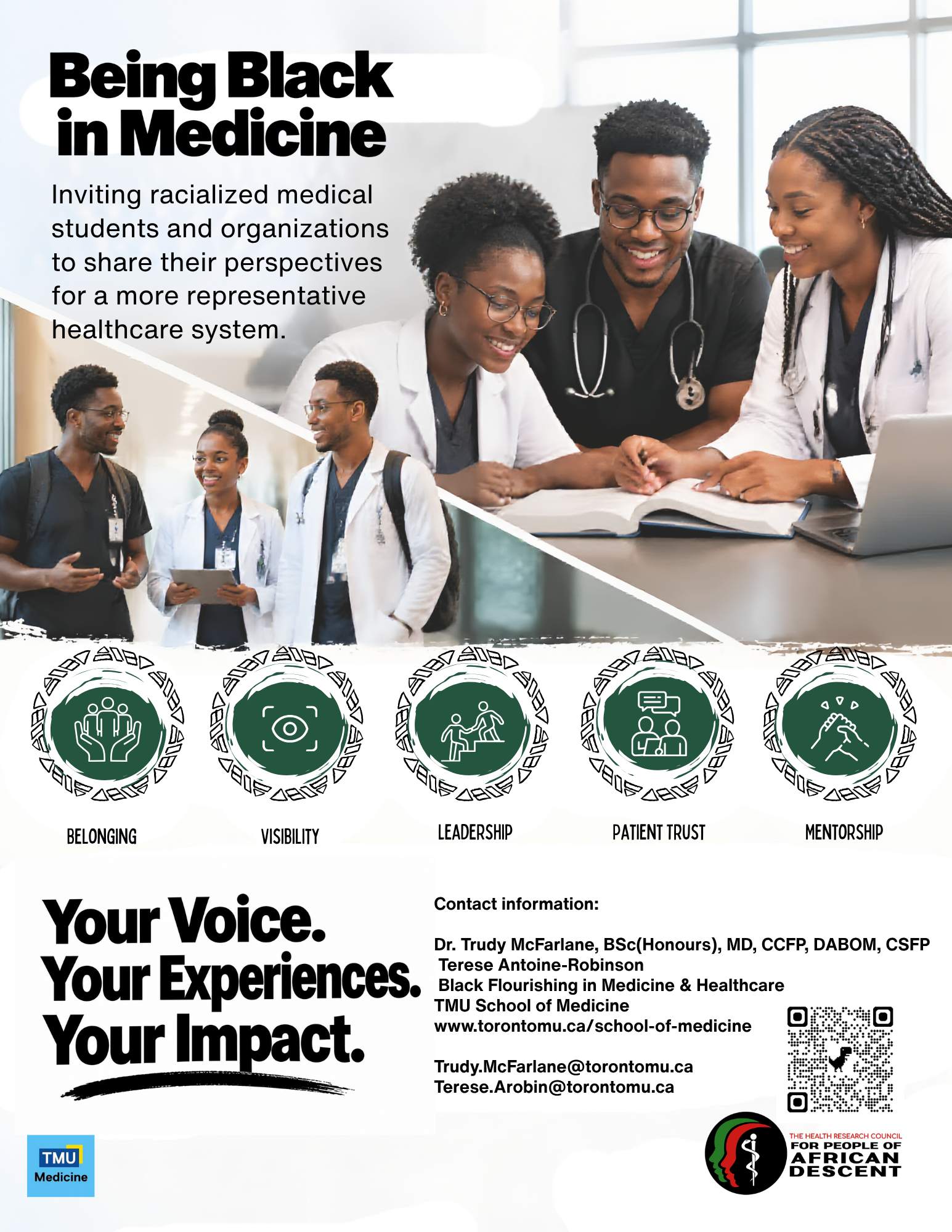
A key deliverable of the Collaborative is the development of opportunities especially for Black medical students and emerging researchers to obtain more exposure to Black health research and to students and emerging researchers.
The partnership will create pathways for students and emerging scholars to participate in Black health research, develop research competencies, engage with community partners, receive mentorship, and contribute to projects addressing real-world health priorities.
Representation in research matters.
The Collaborative seeks to ensure that Black students can see themselves not only as participants in research, but as researchers, scholars, clinicians, knowledge producers, and future leaders in health and healthcare.
Through mentorship and experiential learning, the Collaborative will help connect academic training with community priorities and applied health research.
Community–Academic Research Partnerships
The Collaborative will also serve as a platform for developing partnerships among:
- Black communities and community organizations;
- students and emerging researchers;
- academic researchers and faculty;
- clinicians and healthcare organizations;
- policymakers and health system leaders; and
- organizations working to advance Black health equity.
This approach recognizes that no single institution possesses all of the knowledge or capacity required to address complex health inequities.
Academic expertise and community expertise are complementary. The Collaborative seeks to create structures through which both can meaningfully contribute to the research process.
From Evidence to Action
The Collaborative will place particular emphasis on knowledge translation and impact.
Research should not end with publication. Evidence should have pathways into policy, healthcare practice, education, community programming, and health system improvement.
Accordingly, the Collaborative will seek opportunities to translate research findings into:
- policy and practice recommendations;
- community-facing knowledge products;
- research and policy briefs;
- educational and training resources;
- presentations and knowledge-sharing forums;
- opportunities for further research and funding; and
- partnerships that support implementation and evaluation.
An important question throughout this work will be:
Who benefits from the knowledge being produced, and how can that knowledge contribute
to meaningful change?
Community Data Sovereignty and Responsible Research
Data is central to understanding Black health inequities. Yet the collection and use of data about Black communities raises important questions about trust, representation, ownership, governance, privacy, and community benefit.
The Collaborative will therefore explore approaches to community data sovereignty and culturally responsive health research, recognizing that responsible research requires more than simply collecting better data.
It requires consideration of who defines the questions, who controls the data, who interprets the findings, who benefits from the research, and how potential harms are identified and addressed.
This principle will be particularly important as the Collaborative explores emerging areas such as artificial intelligence, digital health, health data, and technology-enabled care.
Get Involved: Students, Researchers and Organizations
For Medical Students and Emerging Researchers
Are you a Black-med students or emerging researcher interested in health, medicine, public health, social sciences, policy, data, technology, or community research?
We want to hear from you.
The Collaborative will explore opportunities for students and emerging scholars to:
- Participate in Black health research projects
- Connect with mentors and experienced researcher
- Develop research and knowledge-translation skills
- Contribute to community-informed research priorities
- Gain experience in community-based and interdisciplinary research
- Connect with Black health researchers, clinicians, and community leader
- Explore opportunities for research collaboration, presentations, and future funding
For Organizations and Community Partners
We are also inviting community organizations, healthcare providers, health systems, research institutions, professional associations, funders, policymakers, and other organizations committed to advancing Black health to explore opportunities for collaboration.
Organizations can contribute by:
- Identifying priority Black health research questions
- Partnering on community-based research
- Providing opportunities for student and emerging researcher engagement
- Sharing community knowledge and expertise
- Supporting knowledge translation and dissemination
- Collaborating on research funding opportunities
- Contributing data, where appropriate and ethically governed
- Supporting evaluation of programs and interventions
- Creating pathways for research findings to inform policy and practice
Partnership does not necessarily begin with a project. Sometimes it begins with a conversation.
If your organization is working to improve health outcomes for Black communities, we invite you to connect with us and explore what we might build together.
Join the Conversation
Connect us below to explore opportunities to participate, collaborate, or partner with the Black Health Research Collaborative.
Get Involved / Contact HRCPAD →
Health Research Council for People of African Descent (HRCPAD)
Dwight Townsend PhD (c), LLM, MA, BHA
Executive Lead, Health Research Council for People of African Descent (HRCPAD)
Email: inof@blackhealthresearch.ca
https://blackhealthresearch.ca/
Toronto Metropolitan University – Office of Black Flourishing
Dr. Trudy McFarlane, BSc(Honours), MD, CCFP, DABOM, CSFP (She/Her)
Interim Associate Dean, Black Flourishing in Medicine & Healthcare
Office of Black Flourishing
Assistant Clinical Professor
School of Medicine
Toronto Metropolitan University (Formerly Ryerson University)
Trudy.McFarlane@torontomu.ca
www.torontomu.ca/school-of-medicine
Terese Antoine-Robinson
Title
Office of Black Flourishing
School of Medicine
Toronto Metropolitan University (Formerly Ryerson University)
terese.arobin@torontomu.ca
www.torontomu.ca/school-of-medicine